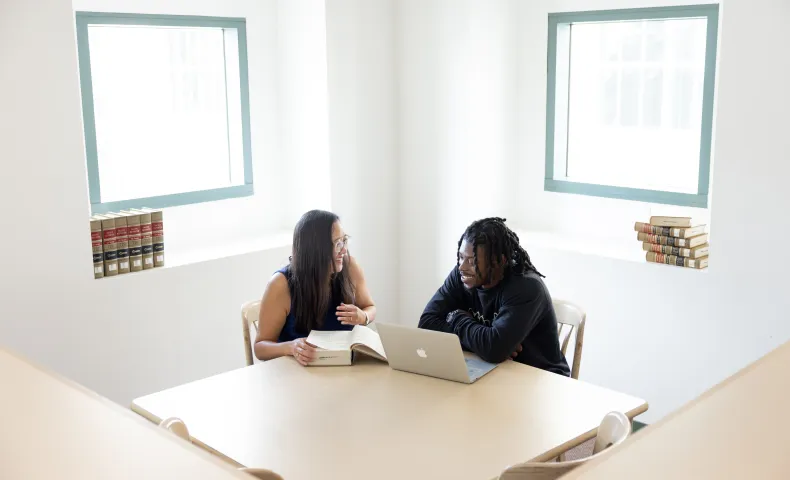
 Photo by Allison Shelley/Complete College Photo Library
Higher Ed’s New Normal: Delivering on the Promise of Online Learning

Over the last decade, we’ve seen a transformation in how students experience higher education. It’s no longer just about attending in-person classes in a campus setting; more and more students are taking classes online. A recent analysis found that more than 53% of college and university students were taking advantage of online or “distance” learning programs. That’s up from a pre-pandemic enrollment rate of roughly 36%.
Online learning can offer huge benefits for students who have traditionally faced barriers to college-going and earning a bachelor’s degree. But alongside the growing uptake of online classes are growing questions about their efficacy and educational value. Here’s a typical critique from a recent article in Cal Matters: “Ask students or professors about the problems of online education, and they’ll point to any number of familiar complaints: a lack of engagement, a sense of loneliness, impersonal lectures, and the temptation to move the Zoom window aside and click on something else.”
As a funder supporting innovative models of online learning in higher education, my response to these critiques is simple: It doesn’t have to be this way. When it’s done right, online learning has the potential to dramatically expand college access and opportunity for today’s students, especially working students, first-generation students, and parents. The key to success is combining high-quality online programs with student supports that foster connection and persistence, like structured mentoring, coaching, peer collaboration, and career-related services.
The “Hybrid Learning” Solution
Emerging “hybrid learning” models that incorporate these elements signal a full reimagining of how students experience higher education, structured from the ground up around student needs. Pioneers in this work include Rivet School, Duet and ASU Local, which is one of our foundation’s partners in advancing hybrid learning.
A program of Arizona State University, ASU Local combines online coursework with intensive in-person and community support. As a California-based funder, we support ASU Local’s programming in Los Angeles, Long Beach, and Chula Vista, plus further expansion efforts in our state. Nationally, ASU Local’s hybrid model has reimagined the college experience for thousands of students—82% from underrepresented communities—by combining flexible learning with personalized support.
I recently had the opportunity to check in with ASU Local alumna Kiana Tovar. As a first-generation student, Kiana had struggled to navigate college with little guidance and fell short of completing her associate degree. In 2024, ASU Local became a turning point for her. After enrolling in 2021, she worked closely with a dedicated “success coach” who helped her choose a major, build a career plan, and access hands-on opportunities.
Between her work commitments and a full course load, Kiana had a lot to juggle while enrolled at ASU Local. Without a hybrid program, completing a four-year degree simply wouldn’t have been possible. ASU Local gave her the flexibility to take courses online on her own schedule, while providing the in-person support and connection she needed to stay on track—from her success coach, professors, and peers. “I felt way more supported than I ever was before,” she shared.
Today, Kiana is creating digital content for the Memphis Grizzlies. She recently won an Emmy Award for a documentary project she and her colleagues produced for the team. It’s a milestone Kiana describes with deep gratitude and disbelief.
Moving Hybrid Programs to Scale
Online learning works best when it’s designed around what students need to succeed. Strong hybrid programs combine the flexibility of online courses with hands-on support, including coaching, mentoring, peer connections, and career guidance. But a central challenge remains: how to scale promising hybrid approaches from isolated pilots into standard practices embedded across postsecondary education.
In April, the Evelyn and Walter Haas, Jr. Fund published From Online to Hybrid Learning: A Roadmap to Transforming Higher Education for Today’s Students. The report acknowledges that most online learning programs simply digitize existing courses in the name of offering more flexibility for students, but without rethinking students’ full needs. The report concludes: “This creates a fundamental tension: flexibility without support can undermine persistence, while support without flexibility can make participation impossible.”
The report draws on insights from 20 models similar to ASU Local to identify the signature practices of promising hybrid learning models. These include:
- Flexible online learning as a scalable foundation. Asynchronous online coursework meets students where they are—removing geographic and scheduling barriers without sacrificing rigor or connection.
- Structured human connection. Proactive coaching, mentoring, and peer cohorts are built into program design; they are not optional add-ons.
- Applied partnerships and career-aligned pathways. Employer and community partnerships are embedded from early on in a student’s journey—not bolted on at the end as a capstone or internship requirement.
- Intentional belonging and accountability. Programs include moments of community and shared purpose—keeping students visible, connected, and accountable to one another.
Sparking Innovation in California and Beyond
Philanthropy has a role in advancing these practices and supporting emerging hybrid models. Indeed, just in the last few months we’ve seen prominent funders launch multimillion-dollar initiatives aimed at expanding equitable access to higher education through more flexible, innovative, and digital learning. For example:
- The College Futures Foundation is spending over $1 million per year to advance innovative system-level changes in California, including strengthening digital infrastructure and improving online learning for adult learners.
- The Gates Foundation, through pooled funding from philanthropic partners, including the Haas, Jr. Fund, will award millions of dollars to new higher education models, including hybrid learning.
At the same time that these funders are putting fresh resources to this work, the state of California is making its own commitments to expanding online and hybrid learning. For example:
- The University of California (UC) Regents recently overturned a ban on fully online degrees by the Academic Senate.
- UC and the California State University system have exceeded their five-year goal for expanding online offerings, increasing online credit hours by more than 400% and 99%, respectively.
- The state allocated $500,000 in one-time funding to the California Community Colleges Chancellor’s Office to outsource a comprehensive study of the nature and value of online and hybrid courses at community colleges.
- The state also funded $15 million for Calbright College, California’s first exclusively online community college built for working adults.
Online learning is emerging as a powerful and increasingly reliable pathway for students seeking a more affordable and flexible route to a bachelor’s degree. Done well, online and hybrid models can open the doors of higher education to many more students—particularly those for whom traditional, campus-based programs may be out of reach. The opportunity ahead is to build on what’s working, pairing the flexibility and reach of online learning with the in-person supports and connections students need to persist and thrive. Higher education leaders, policymakers, and funders all have vital roles to play in making high-quality, student-centered hybrid learning the new normal in higher ed—so that more students can follow Kiana Tovar’s path to college and career success.