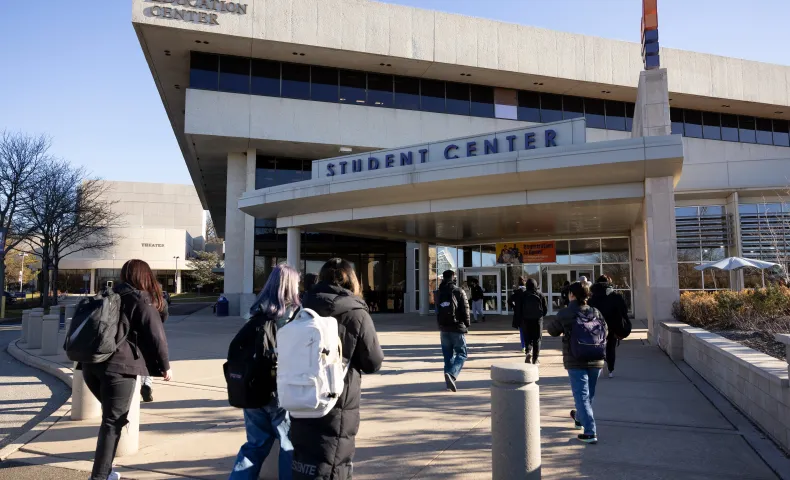
 Photo by Allison Shelley/Complete College Photo Library
Navigating the “Transfer Maze”

For many community college students in California and nationwide, the loss of hard-earned college credits is a huge barrier to transferring successfully to a four-year college or university and earning a bachelor’s degree. The Evelyn and Walter Haas, Jr. Fund is working with partners to tackle the problem.
We recently spoke about the issue with two Haas Jr. partners: Heather Adams, principal with the higher education consulting firm Sova Solutions and founder of Transfer Nation, a multimedia community and knowledge hub for professionals committed to improving transfer outcomes; and Dr. Zachary Pardos, associate professor at UC Berkeley and founder of CourseWise, an AI-powered solution to reduce credit loss and streamline the transfer process.
The Opportunity: Why People Should Care About Transfer
 The California Community Colleges system enrolls more than 2 million students statewide. An overwhelming majority of these students (80%) start community college with the intent of transferring to a four-year college or university and earning a life-changing bachelor’s degree.
Heather Adams: Community colleges serve the students who historically were closed out of or have been marginalized from higher education: first-generation college students, low-income students, undocumented students, immigrants, working students, adult learners. As a proud California community college graduate, I can say unequivocally that my experience transformed not only my educational and professional path, but the possibilities I imagined for my future. The promise of being able to transfer is embedded into our higher education system in California. It’s a promise that you can start at a community college, transfer to a four-year institution, earn a bachelor's degree, and change the economic trajectory of your life and your family's life.
The traditional idea that students can start their college journey in one place, stay in that place full-time, and move neatly to a degree is not the reality for most students today. Transfer is not a side issue. It's crucial to supporting more students to succeed. And it’s also crucial to supporting more higher education institutions to survive. If higher education wants to remain relevant, if it wants to remain affordable and trusted, then we have to get much better at valuing learning wherever that learning happens.
The Problem: Why “Credit Loss” Is A Barrier to Transfer for Countless Students
Despite the fact that most students in the US enter community college intending to transfer, only 33% transfer to a four-year institution, and only 16% earn a degree within 6 years of starting community college1. A big part of the problem is the loss of credits for courses completed in community college; it is estimated that 43% of previously earned credit may be lost by students who transfer2. And a 2025 study found that one in four U.S. adults who tried to transfer college credits said that few or none of their credits transferred.
HA: Students are showing up. They are completing courses. But they can’t be certain those courses are going to transfer or apply to their major. Because a student cannot know where they will be accepted for transfer, they are often forced to bet their credits on a single guess. It’s an incredibly complex system. And that's really unfair, especially for the students who don't have the best advising or the networks and/or the flexibility to figure this out on their own.
Every repeated course because of lost credit can mean another semester. Another semester can mean more tuition, more debt, more work hours, delayed earnings, or stopping out altogether. This loss of time, money, and momentum are lost trust and a lost opportunity for that student. And unfortunately, it's Black and Latino students, students of color, and low-income students who are impacted the hardest, the least likely to make it through the transfer maze we’ve created.
The issue isn't really whether or not students want to transfer. The aspiration is clearly there. The issue is that we are building barriers and not making it easy for students to get through that maze. 
Zachary Pardos: One of the really challenging parts about transfer is that the responsibility for managing transfer of credits is distributed across departments and institutions. There are a lot of different people making what are often very idiosyncratic decisions. It's hard to figure out who's really in charge of it. And a lot of the management and evaluation of credits happen person-to-person and email-to-email between institutions and professors. In California, this is all happening across three huge systems and students can easily get lost. And their credits can easily get lost too.
The Solution: How AI Holds the Potential to Transform Transfer
CourseWise is an AI-powered solution the Haas, Jr. Fund is supporting to streamline and simplify the “course articulation”3 process at the heart of transfer. The platform is based on an algorithm Pardos developed at U.C. Berkeley’s Computational Approaches to Human Learning (CAHL) research lab. Pardos leads the education technology company Equivalence Systems (EQS), which is working to advance the use of CourseWise in higher education. As part of this work, EQS leads ATAIN, a network of higher education institutions that are implementing the CourseWise solution.
ZP: One of the goals of CourseWise is to regularize some of these processes that have developed in an ad hoc way from institution to institution because of how transfer is set up. Step one is to allow institutions and the people in those institutions to more efficiently recognize the pathways to transfer that are supposed to exist between institutions. That means making institutional agreements and policies a part of the software, so it’s simple to make credit decisions on the spot.
And then step two is using AI to make things more efficient and actually expand the pathways for students to get credit for classes they take. CourseWise takes information from these institutions—including transcript, general education requirements, prerequisites, and more—and looks at what courses a transfer student has taken already. It can then help students and the institution maximize legitimate credit transfer towards their intended degree. CourseWise can also help institutions identify gaps in articulation agreements (i.e., course transfer agreements) and provide metrics that show when progress is being made
For example, take the scenario where a student is transferring or has applied to transfer to an institution. CourseWise will evaluate that student’s transcript and check every course against existing articulation agreements. For the courses without an agreement, it will use AI to evaluate which course or degree requirement might be acceptable to give credit for based on past decisions made by faculty and staff.
In the next three years, we are working to get CourseWise integrated into California’s statewide systems of transfer and articulation. We are also looking to give students more visibility into the destination institutions that are offering more opportunities to accept their credit.
HA: This is really groundbreaking work. Students should be able to make their way to a college degree and credentials without needing a secret decoder ring to figure out how higher education works. That’s why CourseWise is so important. It’s going to allow more students to own their educational journey versus getting lost in all these systems.
How Haas Jr. Is Tackling Credit Loss
The Haas, Jr. Fund is working with the following partners to further understanding of the impacts of credit loss on students and advance solutions.
Campaign for College Opportunity: Building and mobilizing a statewide coalition focused on helping students keep and transfer the credits they’ve earned in California.
California Policy Lab: Filling critical gaps in research on credit transfers by examining the extent, causes, and consequences of credit loss among students transferring from California community colleges to public universities.
Transfer Nation: Documenting students’ experiences with credit loss and the complexity of navigating transfer.
ATAIN: Helping California’s public higher education systems adopt and scale AI tools that make the transfer process more efficient and student-centered.
CourseWise: Using AI to help all three of California’s public higher education systems evaluate and transfer credits more efficiently, reducing credit loss for students.
The aim is to create the conditions for a more transparent, equitable, and effective transfer system—one in which students’ credits move with them and accelerate, rather than impede, their path to a degree.
Footnotes
1 Community College Research Center (CCRC)
2 U.S. Government Accountability Office
3 Course articulation is the process of comparing the content of courses that are transferred between postsecondary institutions.