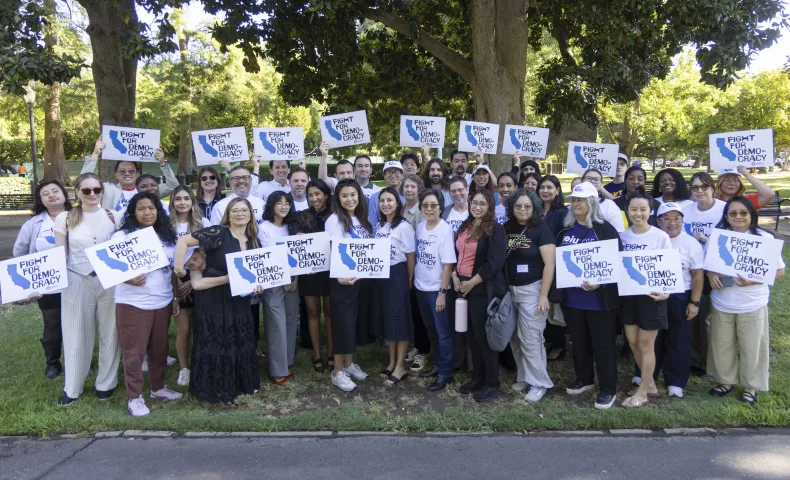
 Photo by Sue Peri
The Power of Partnership

On September 19, California made history with the most substantial expansion of voting rights protections in the state in more than two decades. Two new laws signed by Governor Newsom will make it easier for Californians to vote and will assure they don’t face discriminatory barriers to participating in the democratic process.
The new laws, referred to together as the California Voting Rights Act (CVRA) of 2026, are the result of more than a year of work by the California Democracy Partnership, a collaborative effort that the Haas, Jr. Fund helped to launch with seed funding in 2025. With broad input from racial-justice, civil-rights, labor, and community organizations, the partnership independently developed ambitious reform proposals, educated stakeholders, and inspired lawmakers and the governor to adopt legislation.
The new laws arrive at a pivotal moment. For decades, the federal Voting Rights Act served as the nation’s principal safeguard against racial discrimination in voting. But a series of U.S. Supreme Court decisions has significantly weakened the protections available under federal law for communities of color and other groups that have faced historic and ongoing barriers to voting. Meanwhile, the U.S. government is currently engaged in a concerted effort to make it harder for Americans to vote while sowing fear and chaos about elections.
“The CVRA of 2026 sends a clear message: California will not stand by while the fundamental rights of its voters are threatened. The California Democracy Partnership is proud to help strengthen access to the ballot box and ensure that communities have the power to defend their votes for generations to come,” said Hector Villagra, vice president for policy advocacy and community education at MALDEF, which is a founding member of the partnership.
What the New Law Does
The California Voting Rights Act of 2026 assures that California state law will protect all voters to participate freely and fairly in elections, regardless of the actions of the federal government or the Supreme Court. Here are key goals and provisions of the new law:
- Prohibit voter suppression: Confront discriminatory barriers that impede voter participation and limit access to voting.
- Prohibit vote dilution: Protect against district maps and election systems that weaken or silence a community’s voting power.
- Stop voting discrimination before it occurs: Require jurisdictions with a recent history of voting-rights violations to obtain approval before making certain changes to their election practices, a process known as “preclearance.”
- Ensure voters can protect their rights: Allow Californians to go to state court to enforce their voting rights as federal protections become less reliable.
- Require laws to be interpreted in favor of voters: Direct courts to interpret election laws and exercise their discretion in favor of broad access and equal participation.
- Protect and expand language access: Codify federal language-assistance requirements in state law before they expire and extend coverage to additional language groups.
- Allow more language groups to receive assistance: Give communities that are not adequately represented in U.S. Census data an opportunity to demonstrate their need for language assistance.
Taken together, these provisions establish a state framework that makes California a national leader in voting-rights protections at a time when federal protections are contracting and states must assume greater responsibility for ensuring equal access to the ballot.
A Historic Achievement
The scope of these reforms is notable, as is the speed of their achievement. The Haas, Jr. Fund helped establish the California Democracy Partnership in 2025, providing early funding to participating organizations and seeding a pooled fund at the Silicon Valley Community Foundation that now includes nearly 20 funding partners.
Today, the Partnership is a broad-based group of 18 powerful organizations that reflect the people and communities across California. Throughout the process, members of the Partnership drew on their expertise in civil rights law, election administration, language access in elections, and other topics. Thanks to growing funding support, participating organizations have had the capacity to develop policy, coordinate their work, and respond quickly to the evolving legal and political environment.
For example, when the U.S. Supreme Court’s April 2026 ruling in Louisiana v. Callais created new barriers to challenging political maps that dilute the power of communities of color, the partners adapted recommended reforms in response.
What’s Next
Enactment of this landmark law is a major milestone, but its ultimate impact depends on how it is implemented. State agencies will need to develop guidance and administrative processes, local election officials will need to understand and meet their new responsibilities, and voters and community organizations will need accessible information about the rights and remedies the law provides. Legal capacity will be needed to defend and enforce the law, and candidate pipelines need to be strengthened to take advantage when new opportunities for representation arise.
Going forward, the members of the California Democracy Partnership will remain deeply engaged to help ensure that the law’s protections reach the communities they are intended to serve. The law’s ultimate importance will be measured in communities whose voices are strengthened, barriers that are removed before they affect an election, and voters who are able to participate fully in the democratic process.
There is considerable work ahead to ensure that the California Voting Rights Act of 2026 fulfills its potential. We hope other funders will join the Haas, Jr. Fund and our partners in supporting the California Democracy Partnership as it continues its work to make California a more inclusive, multiracial democracy.