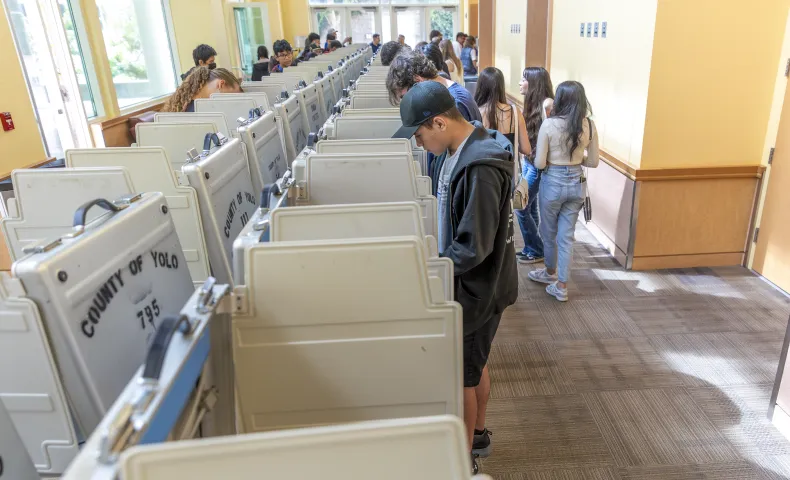
 Photo by Sue Peri
Going Where The Voters Are
What does it take to get more eligible voters to participate in elections, especially those who historically have been underrepresented at the polls? A new report on two local voter education initiatives in California provides answers, as well as takeaways for counties and funders seeking to develop and support effective voter outreach and education.
In 2024, San Mateo and Yolo counties launched innovative programs designed to educate local voters about how, when, and where to vote—based on recently adopted reforms under the California Voter’s Choice Act. The programs were a partnership between each county, local foundations, and nonprofit organizations that were funded to lead nonpartisan voter education initiatives focused on underrepresented communities.
“These voter outreach efforts pursued in San Mateo and Yolo counties really worked,” said Jack Mahoney, senior director, community action at Silicon Valley Community Foundation. “These are models that other counties in California and around the country could almost cut-and-paste to help them drive toward higher voter turnout.”
In the new report on the initiatives, the project partners share the stories of how their collaborative efforts reached large numbers of voters across the two counties and likely contributed to higher-than-expected voter participation in the 2024 election.
Working with “Trusted Messengers”
In each county, voter education and outreach were led by organizations with existing relationships and expertise in targeted communities—particularly youth, non-English speakers, and underrepresented communities of color. Such organizations include those providing food distribution and other direct services, as well as housing organizations, media entities, and advocacy groups. Election officials in the two counties attributed the success of their voter education and outreach initiatives to the participation of these trusted grassroots partners.
Yolo County Chief Elections Officer Jesse Salinas said, “Our goal is to welcome all who want to vote, and our community partners have the networks that help us reach all such potential voters.”
Added San Mateo County’s chief elections officer, Mark Church, “When you don’t go where the voters are, you overlook one of the most important avenues of engagement. We want to use trusted messengers to go where the people are. You don’t have to come to us, we go to you.”
Initiative Highlights
The new report, Innovations in Voter Education, shares key highlights from the two counties’ efforts:
- More than $529,000 in grants awarded to 28 community organizations across both counties, 19 in San Mateo County and 9 in Yolo County.
- Voter outreach prioritized equity and inclusion, primarily reaching youth, non-English speakers, and underrepresented communities of color.
- Grantees contacted more than 135,000 individuals through canvassing, phone banking, outreach activities, and written communications.
- Grantees created unique content and generated at least 200,000 targeted media impressions.
- The report details how voter turnout in the 2024 election was higher than expected among specific populations the grantees targeted. In Yolo County, for example, the 2024 turnout rate beat statewide turnout by 11% in the primary and 9% in the general election, notably higher than the variance in recent election cycles. Meanwhile, in San Mateo County, a League of Women Voters analysis identified an increase in participation in neighborhoods targeted in the primary election, as well as a faster return rate for election ballots in targeted precincts in East Palo Alto.
Local philanthropic institutions were critical participants in the counties’ grantmaking programs. Silicon Valley Community Foundation (SVCF) and Yolo Community Foundation (YCF) selected the grantees, administered the grants, coordinated training, and monitored outcomes. The Evelyn and Walter Haas, Jr. Fund also provided funding and helped establish the effort, particularly in Yolo County.
Special thanks to Catherine Hazelton for drafting this report.